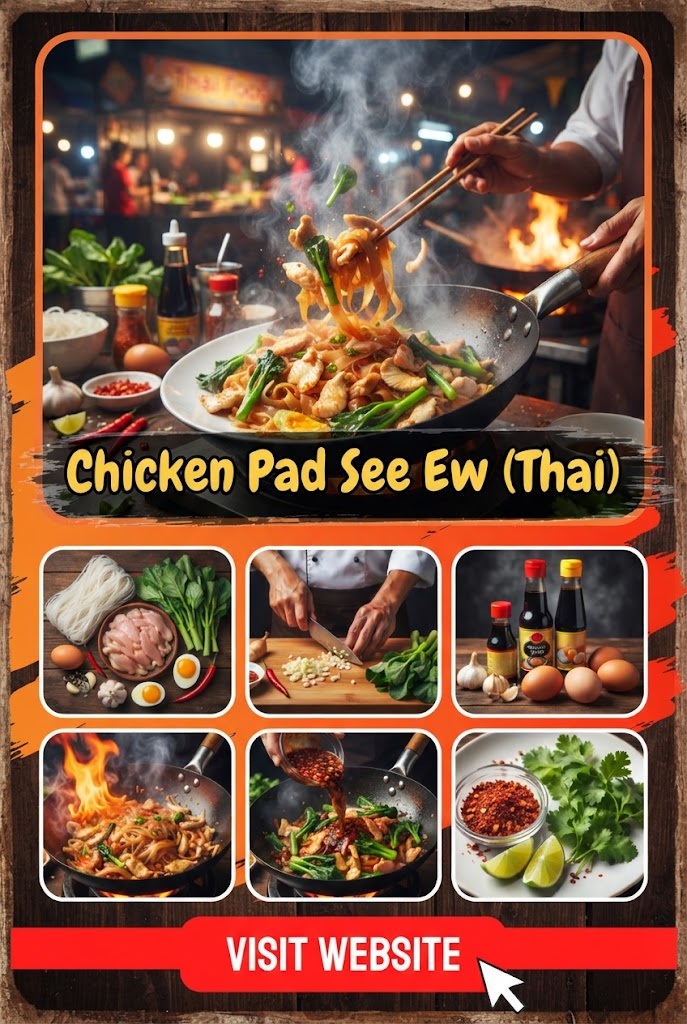
Chicken Pad See Ew (Thai) — Wide Rice Noodles with Tender Chicken
Chicken Pad See Ew is one of Thailand’s most beloved stir-fried noodle dishes. It combines broad, chewy rice noodles with tender chicken, crisp Chinese broccoli, scrambled egg, and a rich, savory sauce. Unlike Pad Thai, which is known for its sweet-tangy balance and peanut garnish, Pad See Ew has a deeper caramelized flavor created by dark soy sauce, light soy sauce, garlic, and high-heat stir-frying.
This recipe is designed for a home kitchen while keeping the essential character of authentic Thai-style Pad See Ew. The key is to prepare everything before you turn on the stove. Once the wok or skillet becomes hot, the cooking moves quickly.
What Is Chicken Pad See Ew?
Pad See Ew, sometimes written as Pad Si Ew or Pad See-Ew, is a Thai-Chinese stir-fried noodle dish. The name refers to stir-fried noodles seasoned with soy sauce. It is commonly prepared with wide rice noodles, Chinese broccoli, egg, and a protein such as chicken, beef, pork, tofu, or shrimp.
The dish is particularly appreciated for its combination of textures. The rice noodles should be soft and chewy, while the vegetables retain a slight crunch. Chicken provides a tender, savory element, and the egg adds richness.
The sauce is equally important. Dark soy sauce contributes color and a slightly sweet, molasses-like depth, while regular soy sauce provides saltiness and savory flavor. Oyster sauce adds body and umami, and a small amount of sugar rounds everything out.
When cooked properly, some of the noodles develop lightly charred edges and caramelized spots. Those browned pieces are one of the best parts of the dish.
Why You’ll Love This Chicken Pad See Ew
There are plenty of reasons to add this recipe to your regular dinner rotation.
Quick and satisfying
Once the ingredients are prepared, the actual stir-frying takes only a few minutes.
One-pan meal
Everything can be cooked in one large wok or skillet, which means less cleanup.
Restaurant-style flavor
High heat and proper sauce proportions create the smoky, savory flavor associated with Thai restaurant Pad See Ew.
Customizable
You can adjust the vegetables, protein, spice level, and sweetness according to your preferences.
Family-friendly
The basic recipe isn’t extremely spicy, making it suitable for many family dinners. Chili flakes, chili vinegar, or fresh chilies can be served separately.
Complete Ingredients
For the Chicken
- 1 pound boneless, skinless chicken thighs or chicken breasts
- 1 tablespoon light soy sauce
- 1 teaspoon oyster sauce
- 1 teaspoon cornstarch
- 1 teaspoon neutral cooking oil
- ½ teaspoon white pepper
- 1 small garlic clove, finely minced
Chicken thighs are particularly good because they remain juicy during high-heat cooking. Chicken breast works well too, provided it isn’t overcooked.
For the Noodles
- 14 ounces fresh wide rice noodles
- 1 teaspoon neutral cooking oil, if needed to prevent sticking
Fresh wide rice noodles are ideal because they have the soft, chewy texture associated with Pad See Ew.
If fresh noodles aren’t available, dried wide rice noodles can be substituted. They should be cooked according to the package directions and drained well before stir-frying.
For the Vegetables
- 2 cups Chinese broccoli, cut into bite-size pieces
- 2 cloves garlic, finely minced
- 1 small carrot, thinly sliced, optional
- 2 green onions, sliced, optional
Chinese broccoli, also called gai lan, is traditional. If you cannot find it, broccoli florets, broccolini, or regular kale can be used.
For the Eggs
- 2 large eggs
- 1 teaspoon neutral oil
For the Pad See Ew Sauce
Combine the following before cooking:
- 2 tablespoons light soy sauce
- 1½ tablespoons dark soy sauce
- 1½ tablespoons oyster sauce
- 1 tablespoon fish sauce
- 1 tablespoon brown sugar
- 1 teaspoon rice vinegar
- 1 tablespoon water
- ½ teaspoon toasted sesame oil, optional
The dark soy sauce is primarily responsible for the characteristic deep brown color. It should not be replaced entirely with regular soy sauce because the flavor and appearance will change.
Optional Garnishes
You can serve the finished noodles with:
- Fresh lime wedges
- Crushed roasted peanuts
- Thinly sliced green onions
- Fresh Thai chilies
- Chili flakes
- Thai chili vinegar
- Extra white pepper
- Cilantro
Traditional Pad See Ew does not need a large amount of garnish. The noodles themselves should remain the star of the dish.
Equipment You’ll Need
A large wok is ideal, but you don’t need special equipment.
Use:
- Large wok or very large skillet
- Sharp knife
- Cutting board
- Small mixing bowl
- Large bowl for noodles
- Wooden spoon or wok spatula
- Tongs
The most important piece of equipment is actually the size of your cooking surface. A crowded pan causes the noodles to steam rather than fry.
How to Prepare the Chicken
Start by slicing the chicken into thin, bite-size pieces.
For chicken breast, slice across the grain into pieces approximately ¼ inch thick. Thin slices cook quickly and remain tender.
Place the chicken in a bowl.
Add:
- Light soy sauce
- Oyster sauce
- Cornstarch
- White pepper
- Garlic
- Cooking oil
Mix thoroughly until every piece is lightly coated.
Allow the chicken to marinate for approximately 15–20 minutes.
You don’t need a long marinade. The small amount of cornstarch is especially useful because it helps protect the chicken from drying out during high-temperature stir-frying.
Preparing the Rice Noodles
Fresh rice noodles require careful handling.
If your fresh noodles are tightly stuck together, separate them gently with your fingers.
Avoid aggressively pulling them apart because they can tear.
If the noodles are refrigerated and very firm, allow them to sit at room temperature for several minutes.
If necessary, briefly loosen them according to the package directions.
The goal is to have noodles that are flexible but not mushy.
Important tip
Do not overcook fresh rice noodles before they reach the wok. They will continue cooking during stir-frying.
If using dried noodles, cook them until just tender. Drain them extremely well.
Excess water can make your stir-fry watery and prevent proper caramelization.
Preparing the Chinese Broccoli
Wash the Chinese broccoli thoroughly.
Separate the thicker stems from the leafy portions.
Cut thick stems into small pieces because they require slightly longer cooking.
Leave the leaves in larger pieces.
This allows the stems to become tender while the leaves remain vibrant.
If the stems are exceptionally thick, blanch them in boiling water for approximately 30–60 seconds and drain before stir-frying.
For thinner stems, blanching is usually unnecessary.
Make the Sauce Before Cooking
This is one of the most important steps.
Combine the light soy sauce, dark soy sauce, oyster sauce, fish sauce, brown sugar, rice vinegar, water, and optional sesame oil in a small bowl.
Stir until the sugar dissolves.
Taste a tiny amount.
It should taste bold and salty with a mild sweetness and deep savory character.
Don’t worry if the sauce tastes too strong by itself. It will be distributed across a large quantity of noodles, chicken, vegetables, and egg.
Having the sauce ready means you won’t have to stop cooking to measure ingredients.
Step-by-Step Cooking Instructions
Step 1: Heat the Wok
Place a large wok over high heat.
Allow it to become very hot.
A hot cooking surface is essential for achieving the characteristic caramelized flavor of Pad See Ew.
Add approximately 1 tablespoon of neutral oil.
Swirl the oil around the wok.
Step 2: Cook the Chicken
Add the marinated chicken in a single layer.
Don’t immediately move it around.
Allow the first side to cook for approximately 45–60 seconds.
Then stir-fry until the chicken is nearly cooked through and lightly browned.
Depending on the thickness of the pieces, this should take approximately 2–4 minutes.
Remove the chicken from the wok and set it aside.
The chicken will finish cooking later with the noodles.
Step 3: Cook the Garlic
Add another small splash of oil if the wok is dry.
Add the minced garlic.
Stir-fry for approximately 10–15 seconds.
Don’t allow the garlic to burn.
You want it fragrant and lightly golden.
Step 4: Add the Chinese Broccoli
Add the broccoli stems first.
Stir-fry for about 30 seconds.
Then add the leafy portions.
Continue cooking for another 30–60 seconds.
The vegetables should remain slightly crisp.
Avoid cooking them until completely soft.
Step 5: Add the Eggs
Push the vegetables toward one side of the wok.
Add a small amount of oil to the empty area.
Crack the eggs into the wok.
Let them sit for several seconds before gently scrambling.
Cook until the eggs are mostly set but still slightly soft.
Do not overcook them.
Step 6: Add the Rice Noodles
Add the prepared wide rice noodles.
Use tongs or a wok spatula to gently separate them.
Avoid aggressive stirring because fresh rice noodles can break.
Spread the noodles across the hot cooking surface.
Let them sit undisturbed for approximately 20–30 seconds.
This helps create browned, caramelized spots.
Then gently toss them.
Step 7: Add the Sauce
Pour the prepared sauce around the noodles.
Adding the sauce around the hot sides of the wok allows it to heat quickly before mixing with the noodles.
Toss gently to distribute the sauce evenly.
The noodles should quickly become a rich brown color.
Step 8: Return the Chicken
Add the cooked chicken back to the wok.
Toss everything together.
Continue stir-frying for approximately 1–2 minutes.
The noodles should become glossy.
The chicken should be completely cooked.
The vegetables should remain slightly crisp.
Step 9: Create the Charred Flavor
This is an optional but highly recommended step.
Spread the noodles into a relatively thin layer across the wok.
Leave them undisturbed for approximately 20–40 seconds.
You’ll hear some sizzling.
The noodles may develop lightly browned edges.
Toss and repeat once if desired.
Don’t burn the noodles.
The goal is caramelization, not scorching.
Step 10: Taste and Adjust
Turn off the heat.
Taste one noodle.
If you want more saltiness, add a small splash of soy sauce.
If you want more sweetness, add a tiny amount of sugar.
If the flavor is too rich, a small squeeze of lime or splash of rice vinegar can brighten it.
Remember that Thai food is often about balance rather than making one flavor dominate.
Serving Chicken Pad See Ew
Serve the noodles immediately while they’re hot.
Transfer them to individual plates or shallow bowls.
Garnish lightly with sliced green onions, fresh chilies, chili flakes, or a lime wedge.
For a more traditional Thai-style meal, serve a small bowl of chili vinegar or sliced chilies in vinegar alongside the noodles.
Pad See Ew is best enjoyed immediately because the noodles gradually become firmer as they cool.
What Does Chicken Pad See Ew Taste Like?
Chicken Pad See Ew has a rich and savory flavor.
The dark soy sauce contributes deep color and gentle sweetness.
Light soy sauce adds saltiness and umami.
Oyster sauce gives the dish body and a slightly sweet seafood-derived savoriness.
Fish sauce adds another layer of depth.
Brown sugar rounds out the salty ingredients.
Rice vinegar provides a small amount of acidity that prevents the sauce from becoming heavy.
The final dish should taste savory first, with mild sweetness and subtle acidity.
The Secret to Restaurant-Style Pad See Ew
1. Use high heat
High heat is crucial.
Low heat causes the ingredients to release water, creating soft, steamed noodles instead of stir-fried noodles.
2. Don’t overcrowd the wok
If your wok is small, cook in batches.
Too many noodles at once lower the temperature.
A large skillet can also work extremely well.
3. Prepare everything first
Pad See Ew cooks quickly.
Have the chicken, vegetables, noodles, sauce, and eggs ready before you start.
4. Don’t overwork the noodles
Rice noodles are delicate.
Use gentle tossing motions.
5. Let the noodles touch the pan
Constant movement prevents browning.
Allowing the noodles to sit briefly against the hot wok creates delicious caramelized areas.
Fresh vs. Dried Rice Noodles
Fresh noodles are the preferred choice.
They have a soft, chewy texture and can develop excellent caramelized edges.
However, dried noodles are much easier to find.
If using dried noodles:
- Cook according to the package directions.
- Stop cooking when they are just tender.
- Drain completely.
- Rinse briefly if necessary to remove excess starch.
- Toss with a tiny amount of oil.
- Use them promptly.
Don’t leave cooked noodles sitting in water.
They can become soggy and difficult to stir-fry.
Best Chicken for Pad See Ew
Chicken thighs
Chicken thighs are my first choice.
They’re juicy, flavorful, and forgiving.
They work especially well with the high heat required for stir-frying.
Chicken breast
Chicken breast is leaner and works perfectly when sliced thinly.
Avoid cooking it too long.
Ground chicken
Ground chicken can also be used, although the texture will be different.
Break it into small pieces while stir-frying.
Vegetable Substitutions
Chinese broccoli is traditional, but you have plenty of alternatives.
Broccolini
Excellent because the stems remain crisp and the leaves cook quickly.
Regular broccoli
Cut the florets into small pieces and thinly slice the stems.
Kale
Remove thick stems and cut the leaves into manageable pieces.
Bok choy
Baby bok choy works well but produces a slightly different flavor.
Spinach
Spinach cooks extremely quickly, so add it near the end.
Common Mistakes to Avoid
Mistake 1: Using too much sauce
More sauce does not automatically mean more flavor.
Too much sauce can make the noodles wet and overly salty.
Start with the recommended amount.
Mistake 2: Cold, wet noodles
Wet noodles prevent browning.
Drain them thoroughly before cooking.
Mistake 3: Low heat
Low heat produces steaming instead of stir-frying.
Use high heat throughout the cooking process while watching carefully to prevent burning.
Mistake 4: Overcrowding
If your pan isn’t large enough, cook the chicken separately and keep ingredients in manageable quantities.
Mistake 5: Overcooking chicken
Thin chicken pieces cook very quickly.
Remove them when they’re almost done and return them to the wok later.
Mistake 6: Breaking the noodles
Use tongs or a broad spatula.
Toss gently.
How to Make It Spicy
Traditional Pad See Ew is not necessarily very spicy.
If you enjoy heat, serve one or more of these alongside the finished noodles:
- Thai bird’s eye chilies
- Chili flakes
- Chili crisp
- Fresh sliced jalapeño
- Thai chili vinegar
For a mild version, add just a pinch of chili flakes.
For a hot version, use sliced Thai chilies.
How to Make Vegetarian Pad See Ew
Replace chicken with:
- Firm tofu
- Mushrooms
- Extra vegetables
- Plant-based chicken
Replace fish sauce with additional soy sauce or a vegetarian mushroom-based seasoning.
Use vegetarian oyster sauce if available.
The cooking process remains essentially the same.
How to Make Chicken Pad See Ew Gluten-Free
Use certified gluten-free soy sauce or tamari.
Check the oyster sauce label carefully because formulations vary.
Choose gluten-free fish sauce and rice noodles.
Always check individual product labels if gluten avoidance is important.
Meal Prep and Storage
Chicken Pad See Ew is best fresh, but leftovers can be stored.
Allow the noodles to cool slightly.
Place them in an airtight container and refrigerate.
They are best consumed within approximately 3–4 days.
For food safety, refrigerate leftovers promptly rather than leaving them at room temperature for extended periods.
How to Reheat Pad See Ew
The best method is a skillet or wok.
Heat a small amount of oil over medium-high heat.
Add the refrigerated noodles.
Add 1–2 teaspoons of water.
Cover briefly to create steam.
Then uncover and toss until the noodles are hot.
Avoid repeatedly reheating the entire batch.
Instead, heat only the portion you plan to eat.
Microwave reheating is possible, but the noodles may become softer and stickier.
Can You Freeze Chicken Pad See Ew?
You can freeze it, but the texture of the rice noodles may change.
Freshly cooked Pad See Ew is significantly better.
If freezing is necessary, allow the dish to cool completely before transferring it to an airtight freezer-safe container.
Thaw it in the refrigerator.
Reheat in a hot skillet with a small amount of oil.
What to Serve With Chicken Pad See Ew
Because Pad See Ew is already a complete meal, it doesn’t require many side dishes.
Good options include:
Thai cucumber salad
A crisp cucumber salad provides refreshing acidity.
Fresh fruit
Pineapple, watermelon, or mango can provide a refreshing contrast.
Thai spring rolls
These make the meal more substantial when serving guests.
Tom Yum Soup
The spicy, sour broth creates an excellent contrast with the rich noodles.
Fresh herbs
Thai basil and cilantro can provide additional freshness.
Nutrition Considerations
The exact nutritional content depends on the brands and quantities of ingredients used.
Chicken provides protein.
Rice noodles supply carbohydrates for energy.
Chinese broccoli contributes fiber and micronutrients.
Egg provides additional protein and fat.
Soy sauce, fish sauce, and oyster sauce can make the dish relatively high in sodium, so people watching their sodium intake can reduce the amount of salty sauces and use lower-sodium alternatives where appropriate.
Frequently Asked Questions
Can I make Pad See Ew without a wok?
Absolutely.
A large, heavy skillet works very well.
Choose the largest pan you have so the noodles have enough room to contact the hot surface.
Why are my noodles breaking?
They may be overcooked or handled too aggressively.
Fresh noodles are delicate.
Cook them briefly and toss gently.
Why is my Pad See Ew watery?
The noodles may have contained too much water, the vegetables may have released moisture, or the pan may not have been hot enough.
Drain noodles thoroughly and use high heat.
Can I use regular soy sauce instead of dark soy sauce?
Yes, but the finished dish will have a lighter color and somewhat different flavor.
For the most characteristic Pad See Ew appearance, use dark soy sauce.
Can I use chicken breast?
Yes.
Slice it thinly and avoid overcooking.
Chicken thighs are more forgiving, but breast meat can produce excellent results.
Is Pad See Ew spicy?
Traditional Pad See Ew is generally mild.
Heat can be added with fresh chilies, chili flakes, or chili vinegar.
Can I make this ahead?
You can prepare all the ingredients ahead of time, which is actually ideal.
Slice the chicken, prepare the vegetables, mix the sauce, and loosen the noodles.
Then cook everything immediately before serving.
Expert Tips for the Best Chicken Pad See Ew
Use a very hot pan. This creates the smoky, caramelized flavor.
Prepare the sauce first. Stir-frying happens too quickly to measure ingredients during cooking.
Keep the noodles dry. Excess moisture works against browning.
Cook chicken separately. This prevents overcooking and gives the chicken better color.
Don’t overcrowd the wok. Work in batches if necessary.
Use wide noodles. They provide the characteristic chewy texture and hold the sauce beautifully.
Don’t constantly stir. Give the noodles time to brown.
Balance the sauce. Pad See Ew should be savory, slightly sweet, and deeply aromatic rather than overwhelmingly salty.
Complete Recipe Card
Chicken Pad See Ew (Thai)
Prep Time: 20 minutes
Marinating Time: 15–20 minutes
Cook Time: 10–15 minutes
Total Time: Approximately 45–55 minutes
Servings: 4
Cuisine: Thai
Course: Main Course
Difficulty: Easy to Moderate
Ingredients
Chicken
- 1 lb boneless, skinless chicken
- 1 tablespoon light soy sauce
- 1 teaspoon oyster sauce
- 1 teaspoon cornstarch
- 1 teaspoon neutral oil
- ½ teaspoon white pepper
- 1 minced garlic clove
Noodles
- 14 oz fresh wide rice noodles
Vegetables
- 2 cups Chinese broccoli
- 2 minced garlic cloves
- 1 carrot, optional
- 2 green onions, optional
Eggs
- 2 large eggs
- 1 teaspoon oil
Sauce
- 2 tablespoons light soy sauce
- 1½ tablespoons dark soy sauce
- 1½ tablespoons oyster sauce
- 1 tablespoon fish sauce
- 1 tablespoon brown sugar
- 1 teaspoon rice vinegar
- 1 tablespoon water
- ½ teaspoon sesame oil, optional
Instructions
- Slice the chicken thinly.
- Mix chicken with soy sauce, oyster sauce, cornstarch, oil, white pepper, and garlic.
- Marinate for 15–20 minutes.
- Prepare and loosen the rice noodles.
- Wash and cut the Chinese broccoli.
- Mix all sauce ingredients in a small bowl.
- Heat a large wok over high heat.
- Add oil and stir-fry the chicken until nearly cooked through.
- Remove chicken and set aside.
- Add garlic and stir-fry briefly.
- Add broccoli stems, followed by the leaves.
- Push vegetables aside and scramble the eggs.
- Add rice noodles.
- Pour in the prepared sauce.
- Gently toss until the noodles are evenly coated.
- Return the chicken to the wok.
- Stir-fry until the chicken is completely cooked and everything is hot.
- Allow the noodles to sit briefly against the hot wok to develop caramelized edges.
- Taste and adjust seasoning.
- Serve immediately with lime, chilies, or other desired garnishes.
Final Thoughts
Chicken Pad See Ew is a wonderful example of how a handful of simple ingredients can create an incredibly satisfying meal. The combination of wide rice noodles, tender chicken, crisp Chinese broccoli, egg, garlic, and a deeply savory soy-based sauce makes this dish both comforting and exciting.
The biggest difference between an ordinary noodle stir-fry and excellent Pad See Ew comes down to technique. Prepare everything before cooking, use high heat, avoid overcrowding the pan, keep the noodles reasonably dry, and give them enough time to develop those beautiful caramelized spots.
Once you master those principles, you can make restaurant-style Chicken Pad See Ew at home whenever you’re craving a fast, flavorful Thai dinner.
